Best Crypto to Buy Now: AI-Driven Bear Market Analysis 2026

Best Crypto to Buy Now: AI-Driven Analysis for the 2026 Bear Market
Last updated: April 11, 2026 | Bitcoin: ~$69,000 | Fear & Greed Index: 13 (Extreme Fear) | BTC dominance: 56.8%
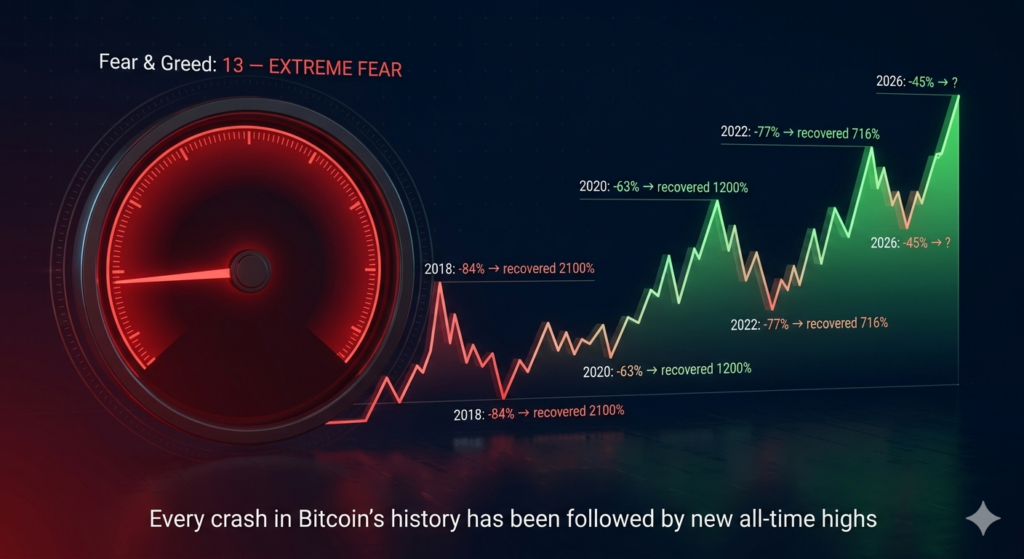
The crypto market has lost over 45% from its October 2025 peak. Bitcoin dropped from $126,198 to $69,000. Ethereum is down over 55%. Most altcoins have been devastated — the median token fell 79% in 2025 alone. The Fear & Greed Index reads 13, deep in “extreme fear” territory. Social media is filled with calls that “crypto is dead.”
And yet, this is precisely the environment where the most profitable crypto investments in history have been made. Every major Bitcoin drawdown — without exception — has been followed by a full recovery and new all-time highs. The question has never been if, but when and what to buy.
This isn’t a generic “top 10 coins” listicle. This is a data-driven analysis using on-chain metrics, AI-powered evaluation, macro context, and fundamental research to identify which cryptocurrencies offer the best risk-adjusted opportunity in the current bear market — and which ones to avoid entirely.
Why Bear Markets Create the Best Buying Opportunities
Fear feels terrible. But fear is what creates value. The math is straightforward: every asset you buy at $69K instead of $126K gives you roughly 83% more upside to the same target. The investors who bought Bitcoin at the depths of previous crashes — $3K in 2018, $16K in 2022 — didn’t do it because the market felt safe. They did it because the data told them the risk-reward was asymmetric.
Here’s what the data shows right now:
On-chain signals point to accumulation, not capitulation. Long-term holders (addresses holding BTC for 155+ days) control over 78% of total supply — one of the highest readings in Bitcoin’s history. These are the experienced holders who have survived multiple cycles. They’re not selling. Exchange reserves are at their lowest since 2018, meaning coins are moving to cold storage, not to sell.
Bitcoin is not overvalued by any metric. The MVRV ratio (Market Value to Realized Value) is at 1.8. Cycle tops have historically occurred at MVRV readings of 3.5-4.0. Bitcoin is trading just 21% above its realized price of ~$54,000 — closer to a cycle bottom than a top by every historical precedent.
Smart money is buying aggressively. Strategy (formerly MicroStrategy) purchased 89,618 BTC in Q1 2026 — its second-biggest quarter ever. BlackRock’s IBIT holds over $58 billion in BTC. The U.S. government established a Strategic Bitcoin Reserve. These entities don’t buy during panic — they buy when they see value.
The catalyst for the crash was macro, not structural. The February 2026 decline was triggered by tariff escalation and the Iran-U.S. conflict — external shocks that affected all risk assets, not a fundamental failure of any crypto network. When the macro resolves (and ceasefire negotiations are underway as of April 7), the recovery can be rapid because the underlying networks never stopped working.
How We Evaluate: The AI-Driven Analysis Framework
Instead of picking coins based on hype or price performance, we apply a systematic framework that evaluates each asset across five dimensions. This is the same methodology we describe in detail in our AI altcoin evaluation guide:
- On-chain fundamentals: Active addresses, transaction volume, TVL, revenue, smart money accumulation
- Tokenomics health: Supply schedule, FDV/MC ratio, upcoming unlocks, inflation rate (full tokenomics guide)
- Development activity: GitHub commits, protocol upgrades, team engagement
- Market position: Category leadership, competitive moat, institutional adoption
- Risk-adjusted valuation: Current price vs. on-chain fair value metrics, distance from realized price, cycle positioning
Each asset below includes a score card based on this framework. We’ve organized picks into three risk tiers so you can build a strategy that matches your risk tolerance.
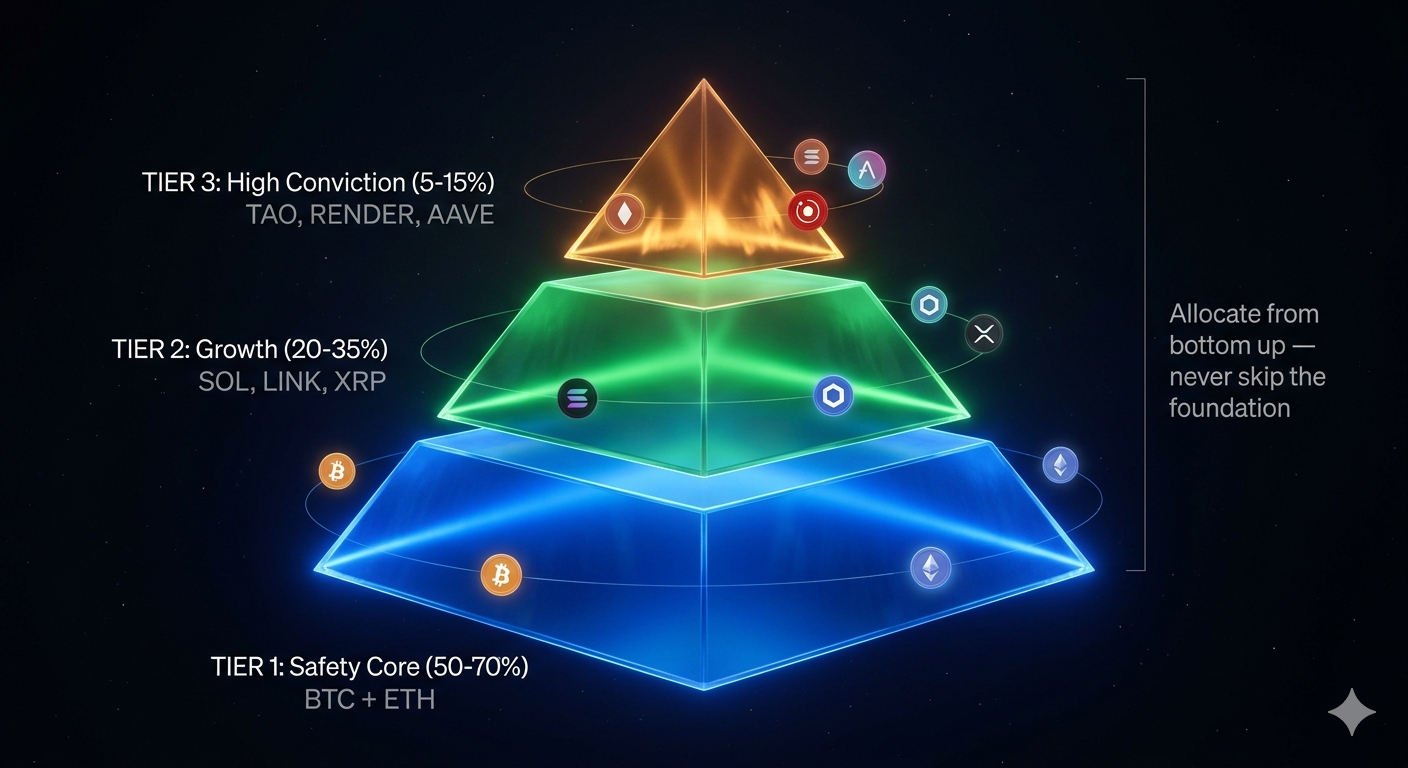
Tier 1: The Safety Core (50-70% of Allocation)
These are the assets with the highest probability of surviving the bear market and reaching new all-time highs in the next cycle. If you’re uncertain about anything else, these two are the foundation.
Bitcoin (BTC) — The Anchor
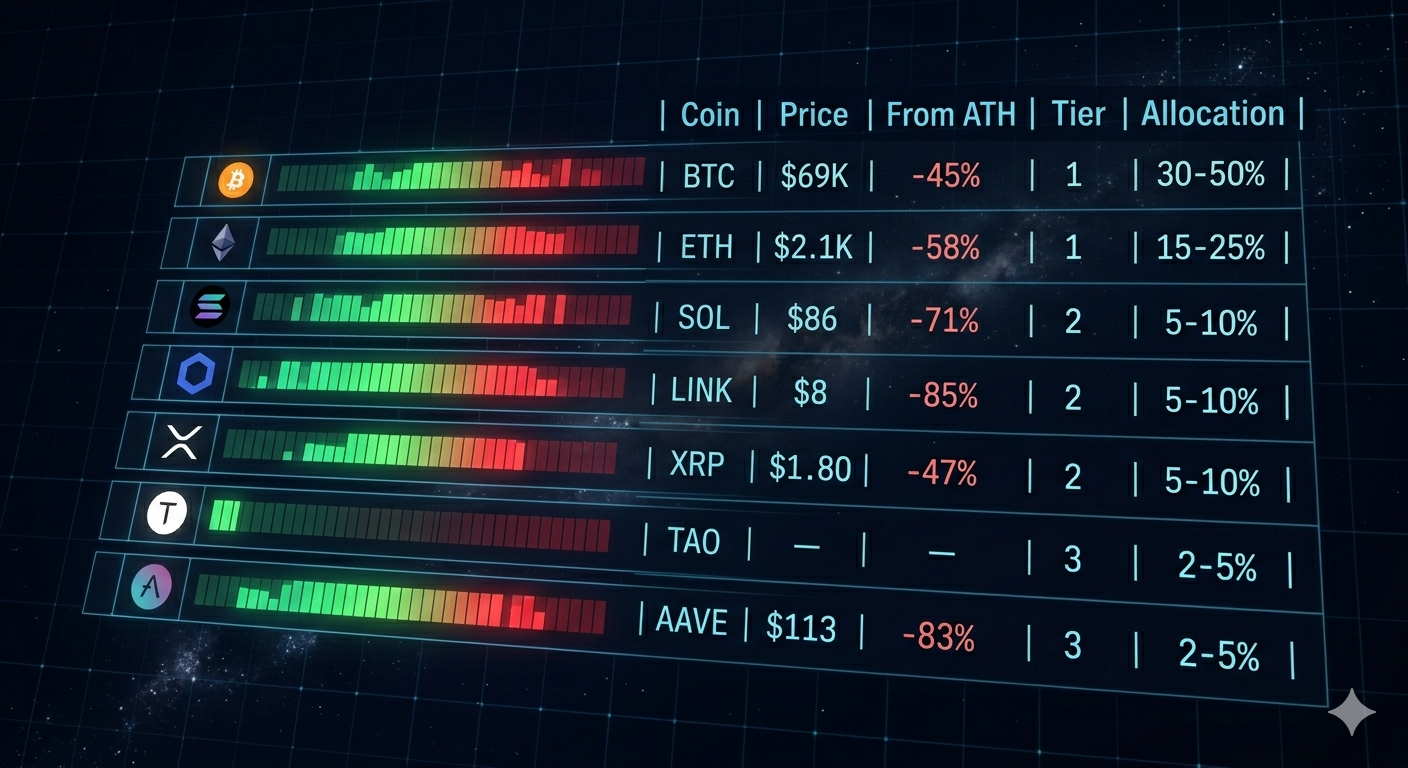
Current price: ~$69,000 | ATH: $126,198 | Drawdown: -45% | Market cap: $1.33T
The bull case: Bitcoin has survived every bear market in its history — including 80%+ drawdowns — and reached new highs every time. The current drawdown (-45%) is moderate by historical standards. Post-halving supply dynamics remain favorable: miners produce ~450 BTC/day while ETF demand averaged 1,200+ BTC/day in Q1 2026. The supply-demand math is structurally bullish.
On-chain data: MVRV at 1.8 (far from overheated). Realized price at $54K provides strong support. LTH supply at 78% — the highest in history. Exchange reserves at 6-year lows.
Key risk: Prolonged geopolitical crisis forcing Fed rate hikes. Bear case floor: $45K-$50K (previous cycle peak).
Verdict: Bitcoin at $69K is the asymmetric bet of this cycle. You’re buying 45% below ATH with the strongest institutional backing in crypto history. This is where 30-50% of your crypto allocation should sit.
Ethereum (ETH) — The Contrarian Value Play
Current price: ~$2,100 | ATH: $4,954 | Drawdown: -58% | Market cap: $233B
The bull case: Ethereum is the most hated major crypto asset right now — and that’s precisely why it’s interesting. The narrative that “Layer 2s are cannibalizing Ethereum” and “Solana killed ETH” has created what may be the most asymmetric risk-reward in the market. Ethereum still anchors the majority of DeFi’s TVL, hosts the largest smart contract ecosystem, and is the blockchain of choice for institutional RWA tokenization ($20B+ on Ethereum by April 2026). The Glamsterdam upgrade introduced Smart Accounts, making Ethereum wallets as user-friendly as banking apps.
On-chain data: ETH staking yield stable at 3.5-4.2%, providing a “risk-free rate” for the crypto ecosystem. EIP-1559 burn mechanism remains active. When network activity recovers, ETH becomes deflationary.
Key risk: Continued narrative shift toward Solana. ETH ETF flows have been negative for 5 consecutive months. If DeFi usage doesn’t rebound, the thesis weakens.
Verdict: ETH below $2,000 is deep value territory for the world’s largest programmable blockchain. Allocate 15-25% here, with the understanding that the recovery may take longer than BTC.
Tier 2: Growth Picks (20-35% of Allocation)
Higher volatility, higher potential upside. These projects have strong fundamentals and large ecosystems but carry more risk than BTC/ETH. They tend to fall harder during crashes and recover faster during rallies.
Solana (SOL) — The Speed Machine
Current price: ~$86 | ATH: ~$294 | Drawdown: -71% | Market cap: ~$42B
The bull case: Solana dominates in daily active users and stablecoin transfer volume. The Alpenglow upgrade (expected 2026) promises 150ms finality — attracting high-frequency trading institutions. Multiple spot SOL ETF applications are pending SEC approval. With 27.1 million active addresses, Solana has the most vibrant on-chain economy outside Ethereum.
Key risk: SOL is “high beta” — it outperforms in bull markets and underperforms in bear markets. The 71% drawdown proves this. Only buy if you can stomach 5-10% daily swings.
Verdict: The best risk-reward among L1 alternatives. Potential SOL ETF approval would be a massive catalyst. Allocate 5-10%.
Chainlink (LINK) — The Infrastructure Backbone
Current price: ~$8 | ATH: $52 | Drawdown: -85%
The bull case: Every DeFi protocol, every RWA tokenization project, every cross-chain application needs oracle data — and Chainlink is the dominant provider. LINK’s price has been crushed, but its utility hasn’t: the network processes billions in transaction value daily. The disconnect between Chainlink’s critical infrastructure role and its deeply discounted price creates a textbook contrarian opportunity.
Key risk: LINK has struggled to capture value relative to usage. The token’s utility as a payment for oracle services hasn’t translated into sustained price appreciation in past cycles.
Verdict: If DeFi and RWA recover (high probability over 12-24 months), LINK at $8 looks deeply undervalued. Allocate 5-10%.
XRP — The Institutional Payments Play
Current price: ~$1.80 | ATH: ~$3.40 | Drawdown: -47%
The bull case: With regulatory clarity established in major jurisdictions, XRP continues to see institutional integration into cross-border payment rails across Asia-Pacific and the Middle East. The funding rate is notably lower than ETH and SOL, indicating the dip is being absorbed by long-term holders rather than overleveraged traders. Multiple ETF filings for spot XRP are pending.
Key risk: XRP’s upside is more measured than high-beta assets. Bull case projections cap at $3-6, meaning 2-3x from current levels — good, but not life-changing compared to earlier-stage projects.
Verdict: A defensive pick for risk-conscious investors who want altcoin exposure without extreme volatility. Allocate 5-10%.
Tier 3: High-Conviction AI & Infrastructure (5-15% of Allocation)
This tier carries the highest risk but also the highest potential upside. These are emerging narrative plays in the AI-crypto intersection — the dominant growth sector of 2026 according to multiple research firms. For a deeper analysis of this space, see our AI crypto agents analysis.
Bittensor (TAO) — Decentralized AI Training
Why it stands out: Bittensor completed the largest LLM training run ever recorded on a decentralized network in early 2026, proving that peer-to-peer networks can rival centralized AI infrastructure. The protocol incentivizes collaborative machine learning through specialized subnets. It’s the infrastructure layer for the decentralized AI narrative — one of the few crypto-AI projects with verifiable, non-speculative utility.
Key risk: High volatility, relatively low liquidity compared to top-10 assets. The AI-crypto narrative can shift rapidly.
Render (RENDER) — GPU Compute for AI
Why it stands out: As AI inference demand skyrockets, Render has pivoted from CGI rendering to a primary provider of decentralized GPU compute for AI startups. Real revenue, real usage, real demand. This isn’t a narrative play — it’s a business with growing income that happens to be tokenized.
Key risk: Competition from centralized cloud providers (AWS, Azure) and other decentralized compute networks.
Aave (AAVE) — DeFi’s Revenue King
Why it stands out: AAVE hit $1 trillion in cumulative lending volume — a first in DeFi. The protocol holds $27.2 billion in TVL, generated $9.96 million in revenue in January 2026 alone, and controls 61.5% of active DeFi loan market share. At ~$113 (down 83% from ATH of $661), you’re buying DeFi’s most dominant lending protocol at a fraction of its demonstrated revenue capacity.
Key risk: DeFi sector remains suppressed in bear markets. Smart contract risk, regulatory uncertainty around DeFi lending.
What We’re Avoiding — and Why
Equally important as knowing what to buy is knowing what NOT to buy during a bear market. Avoid these categories:
Meme coins. Dogecoin is down 62%, Shiba Inu down 52% in six months, and neither has come close to their 2021 all-time highs. Meme coins are instruments of bull market speculation. In bear markets, they bleed without recovery catalysts. If you want to speculate on memes, wait until the Fear & Greed Index is above 60 — not at 13.
New presale tokens. Bear markets are where scam projects thrive — desperate capital chases “100x” presale promises. The vast majority of presale tokens launched in 2025-2026 have lost 80-95% of their value. Stick to established projects with proven revenue and active ecosystems. For red flags to watch, see our crypto scams guide.
High-FDV, low-float tokens. Tokens with FDV 10-40x above market cap have massive future dilution. Each unlock event creates selling pressure that overwhelms organic demand. Check every token’s tokenomics before buying — especially the unlock schedule.
Leverage in any form. Do not trade futures, options, or margin positions during a bear market unless you’re an experienced professional. The October 2025 liquidation event wiped out $19 billion in leveraged positions in a single day. Spot buying with capital you can afford to lose is the only approach that survives bear markets.
The Bear Market Playbook: How to Execute
Picking the right coins is only half the battle. Execution strategy determines whether you actually profit or buy too early, panic sell at the bottom, and lock in losses. Here’s the playbook:
Dollar-Cost Average (DCA) — Don’t Try to Time the Bottom
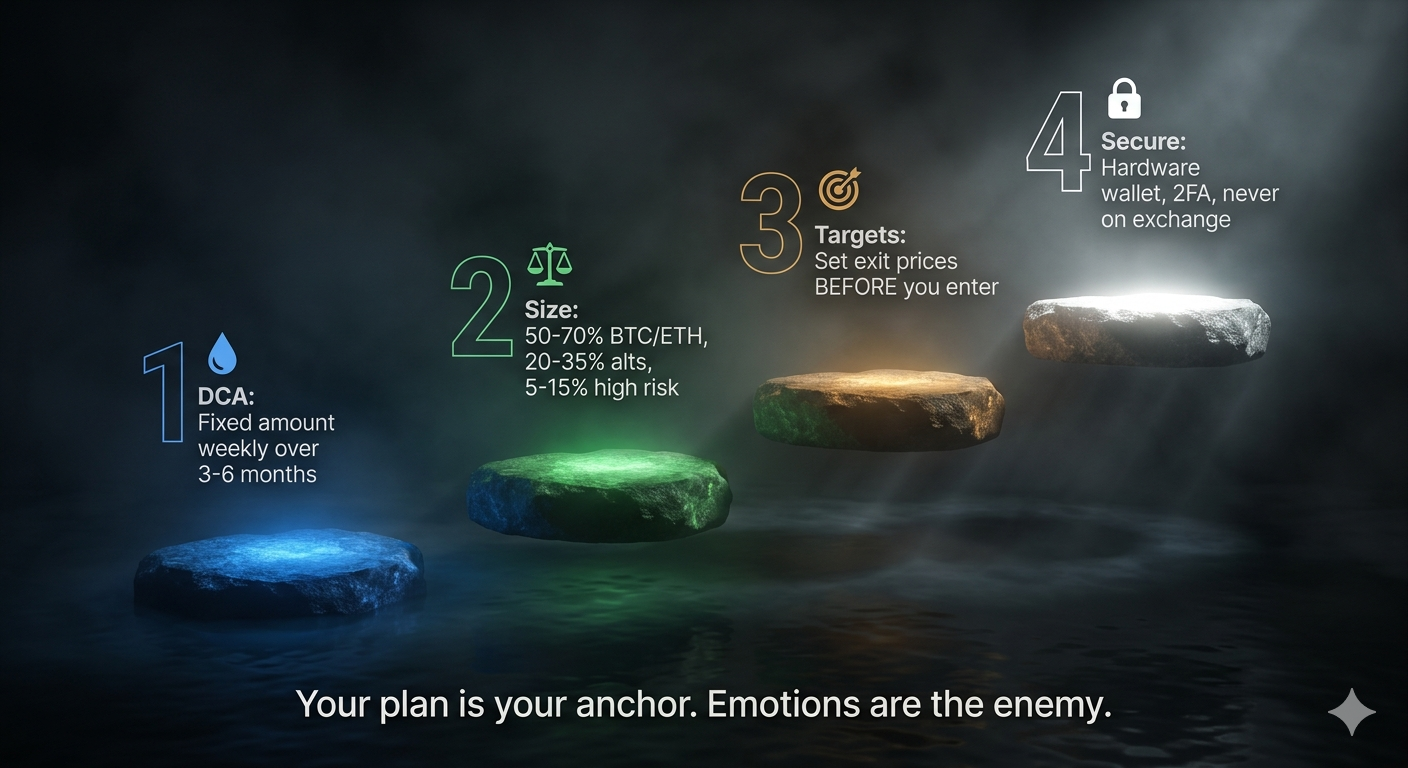
Nobody can reliably call the exact bottom. DCA eliminates the need to try. Set a fixed amount to invest weekly or bi-weekly over the next 3-6 months. This ensures you buy at various price points, reducing the impact of short-term volatility.
Example: $500/month split into weekly purchases of $125. If BTC averages $65K over 6 months, you’ll accumulate at roughly that average regardless of individual weekly swings.
Position Sizing — Never Overcommit
Never put more than 5-10% of your investable net worth into crypto. Within crypto, follow the tier allocation: 50-70% in Tier 1 (BTC/ETH), 20-35% in Tier 2, 5-15% in Tier 3. This ensures that even if your highest-risk picks go to zero, your portfolio survives. For detailed position sizing rules, read our risk management guide.
Set Exit Targets Before You Enter
Before buying a single token, define your target sell prices and your maximum acceptable loss. Write them down. Bear market psychology will tell you to sell at the bottom — your written plan is the anchor that prevents emotional decisions.
Secure Your Holdings
Bear markets are prime time for scams, phishing, and exchange failures. Use a hardware wallet for any significant holdings. Don’t leave crypto on exchanges longer than necessary. Review our complete wallet security guide before making any purchases.
Key Catalysts to Watch
These upcoming events could shift the market direction significantly:
| Catalyst | Impact if Positive | Timeline |
|---|---|---|
| Iran-U.S. ceasefire | Broad risk-on rally across all assets, BTC toward $80K+ | Days to weeks |
| Fed rate cut signal | Liquidity expansion, very bullish for crypto | Q2-Q3 2026 |
| DOL 401(k) crypto guidance | Unlocks $150-450B in potential retirement fund demand | H1 2026 |
| Spot SOL ETF approval | Massive inflow catalyst for Solana, narrative boost for alts | H2 2026 |
| ETF flow reversal to sustained net inflows | Confirms institutional re-entry and bottom formation | Ongoing |
FAQ
Is now a good time to buy crypto?
Historically, periods of extreme fear (Fear & Greed Index below 15) have preceded the best 12-month returns in crypto. Bitcoin’s current MVRV ratio, realized price proximity, and long-term holder behavior all align with previous accumulation zones. However, short-term downside is possible due to macro uncertainty. The safest approach is DCA over 3-6 months rather than a lump-sum entry.
What is the safest crypto to buy during a crash?
Bitcoin is the safest choice. It has the largest market cap, deepest liquidity, strongest institutional backing (ETFs, corporate treasuries, government reserves), and has recovered from every previous crash to reach new all-time highs. Ethereum is the second safest due to its dominant smart contract ecosystem and staking yield.
Should I buy altcoins during a bear market?
Only after you have a solid BTC/ETH core position (50-70% of allocation). Not all altcoins recover — many from previous cycles never returned to their highs. Focus on altcoins with proven revenue, active development, and clear utility. Avoid meme coins, presale tokens, and anything with a FDV/MC ratio above 10x during bear markets.
How much should I invest in crypto during a crash?
Only invest money you can afford to lose entirely. A common guideline is no more than 5-10% of your investable net worth in crypto. Within that allocation, spread purchases over 3-6 months using DCA to reduce timing risk. Never take on debt to buy crypto.
What’s the difference between buying the dip and catching a falling knife?
“Buying the dip” works when fundamentals are intact and the decline is driven by temporary external factors. “Catching a falling knife” happens when you buy based on price alone without checking fundamentals. The difference is research: on-chain data, tokenomics analysis, development activity, and macro context. Every pick in this article is backed by data, not price movement alone.
How will I know when the bear market is over?
No single indicator tells you definitively. Watch for confluence: BTC reclaiming the 200-day SMA, sustained ETF net inflows (not just one good week), Fear & Greed Index consistently above 40, and MVRV rising above 2.0. When multiple signals align, the bottom is likely in. Follow our technical analysis guide to read these signals yourself.
Bottom Line
The 2026 bear market feels terrible. That’s by design — bear markets are engineered to shake out weak hands, liquidate leveraged positions, and transfer assets from impatient sellers to patient buyers. The on-chain data is unambiguous: long-term holders are accumulating at the fastest rate in Bitcoin’s history. Institutions are buying. Exchange reserves are depleted. The structural setup for the next bull run is being built right now, in the depths of fear.
Your job is not to predict the exact bottom. Your job is to have a plan, execute it systematically, and not let emotions override data. Start with BTC and ETH as your foundation. Add selective altcoin exposure only in assets with proven fundamentals. Use DCA. Secure your holdings in a hardware wallet. And set your exit targets before you need them.
We update this analysis weekly as market conditions change. Bookmark this page and check back for the latest data.
Disclaimer: This article is for educational and informational purposes only and does not constitute financial advice. Cryptocurrency investments carry significant risk, including the potential for total loss of capital. Always do your own research and consult a financial advisor before making investment decisions. Some links in this article may be affiliate links.