
How to Spot Promising New Altcoins with AI

In 2025, the median altcoin dropped 79% while Bitcoin stayed relatively flat. Out of thousands of new tokens launched, only a handful of narratives — like RWA tokenization (185% average returns) and select AI infrastructure projects — delivered meaningful gains. The difference between winning and losing in the altcoin market has never been more about research quality and speed.
This is exactly where AI tools change the game. They can scan thousands of tokens, analyze on-chain data, parse social sentiment, and flag patterns that would take a human researcher days to compile. This guide shows you the actual tools, methods, and workflows used to evaluate new altcoins with AI in 2026 — not vague promises, but specific steps you can start applying today.
Why AI Has Become Essential for Altcoin Research
The altcoin market in 2026 has a scale problem. There are over 15,000 actively traded tokens, hundreds of new launches every week, and information scattered across blockchains, social media, GitHub repos, and governance forums. No human can process this volume manually.
AI tools solve three specific problems that traditional research can’t handle at scale:
Speed of data processing. An AI model can analyze on-chain metrics (wallet distribution, transaction volume, holder growth), social sentiment (Twitter/X, Telegram, Reddit), and development activity (GitHub commits, smart contract deployments) for hundreds of tokens simultaneously. What takes a human analyst a full day, AI can deliver in minutes.
Pattern recognition across datasets. The most promising altcoins often show a specific combination of signals before their breakout: growing unique wallets, increasing developer commits, rising social mentions without corresponding price movement, and accumulation by smart money wallets. AI excels at detecting this multi-signal convergence that humans miss when checking each metric in isolation.
Narrative tracking. Crypto markets move in narrative cycles. According to CoinGecko’s 2025 research, the top-performing narratives rotate rapidly — RWA, AI agents, DePIN, meme launchpads — and timing your entry into an emerging narrative before it peaks is critical. AI tools can track capital flows between narratives in real time and flag when a new theme is gaining momentum.
However, AI is a tool, not an oracle. Models achieve directional accuracy of roughly 55–65% at best, and they fail entirely during black swan events, regulatory shocks, or sudden liquidity crises. The goal is to use AI to filter the noise and surface candidates — then apply your own judgment and risk management before committing capital.

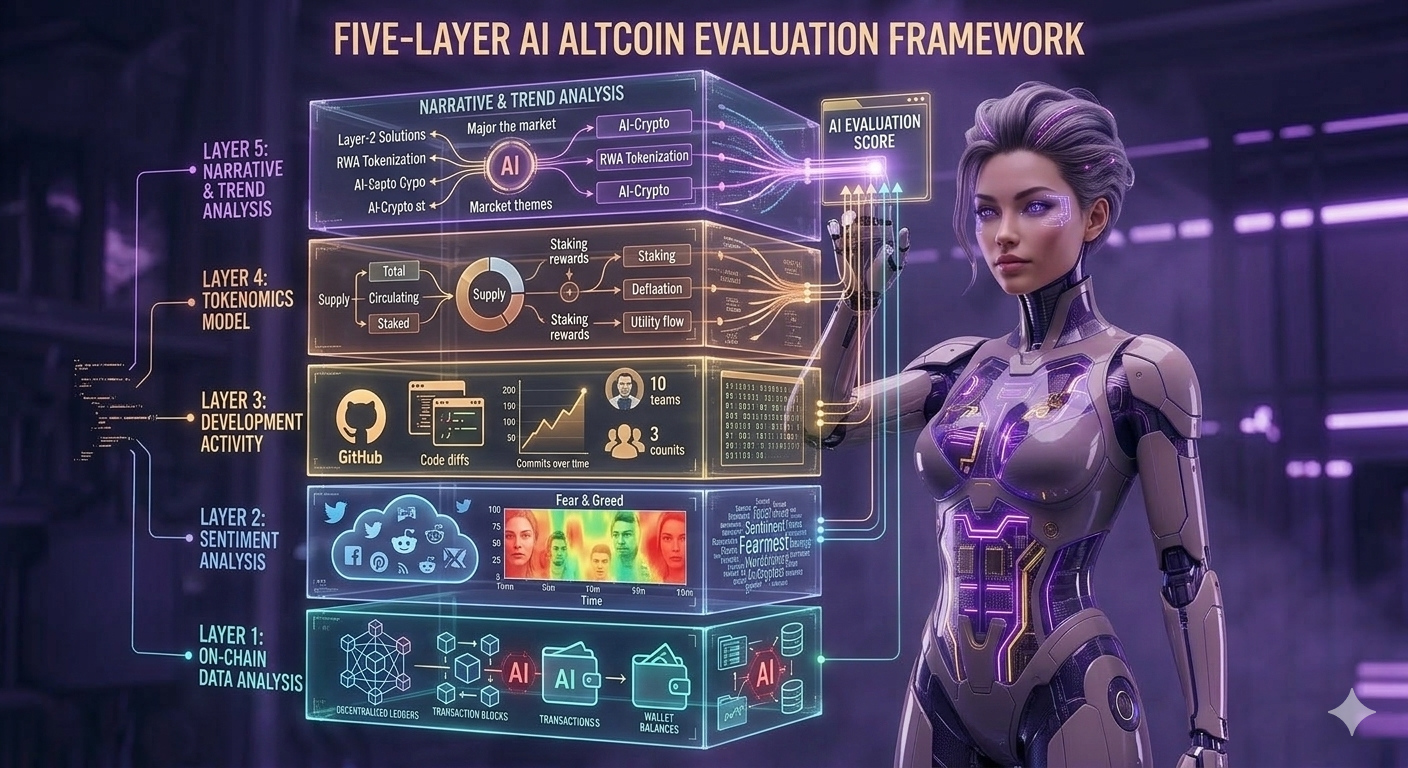
The 5-Layer AI Altcoin Evaluation Framework
Rather than relying on a single AI tool, the most effective approach combines multiple AI-powered data sources into a structured framework. Think of it as five lenses, each revealing different aspects of a token’s potential:
Layer 1: On-Chain Analysis
On-chain data is the ground truth of crypto. Unlike price charts or social hype, it shows what wallets are actually doing with real money. The key metrics AI tools can track:
Unique active addresses (growth trend). A steadily growing number of unique wallets interacting with a protocol signals genuine adoption, not just speculative trading. AI tools can detect inflection points — when growth rate accelerates — which often precede price moves.
Smart money wallet tracking. Tools like Nansen and Arkham Intelligence label wallets belonging to known funds, whales, and successful traders. When multiple smart money wallets start accumulating a token that hasn’t moved in price yet, it’s one of the strongest early signals in crypto. AI aggregators can monitor hundreds of labeled wallets simultaneously.
Token distribution and holder concentration. If the top 10 wallets hold 80%+ of supply, the token is vulnerable to dump risk. AI tools can flag unhealthy concentration and track whether distribution is improving (more holders) or worsening (accumulation by insiders).
TVL and protocol revenue. For DeFi tokens, Total Value Locked and actual revenue generation are the fundamentals that matter. A token with rising TVL and growing fee revenue has a fundamentally different risk profile than one riding pure speculation.
Layer 2: Social Sentiment Analysis
AI-powered sentiment analysis goes beyond counting mentions. Modern NLP models can assess the emotional tone, detect coordinated shill campaigns, and measure organic versus inorganic growth in community engagement.
What to look for: rising organic mentions on Twitter/X, Reddit, and Telegram before a price pump. If sentiment spikes happen after a price move, that’s FOMO — not a leading signal. The ideal pattern is growing positive sentiment with flat or slightly declining price — it means accumulation is happening quietly.
Red flags AI can detect: sudden spikes of bot-generated mentions, coordinated shilling across multiple platforms, and sentiment patterns that match known pump-and-dump profiles.
Layer 3: Development Activity
A project with active development has a fundamentally different outlook than one where GitHub has been dormant for months. AI tools can track:
GitHub commit frequency and quality. Not just commit count (which can be gamed), but the substance of changes — new feature branches, smart contract upgrades, protocol improvements, audit preparations.
Developer count and retention. Is the team growing? Are core developers still active, or have they moved on? A declining developer base is one of the strongest bearish signals for any project — and one that most retail investors never check.
Smart contract deployments and upgrades. New contract deployments on mainnet signal that the team is actively building and shipping, not just writing blog posts and updating roadmaps.
Layer 4: Tokenomics and Unlock Analysis
Many promising projects fail as investments because of poor tokenomics — especially large upcoming token unlocks that create selling pressure. AI can model:
Vesting schedules and upcoming unlocks. If 20% of a token’s supply unlocks next month, even strong fundamentals may not overcome the selling pressure. Tools can overlay unlock schedules on price charts and flag dangerous periods.
Inflation rate. Some tokens have aggressive emission schedules that continuously dilute existing holders. AI models can calculate the real inflation-adjusted return and compare it across competing tokens.
Supply distribution across categories. What percentage goes to team, investors, ecosystem, community? Is there a cliff unlock or gradual vesting? How does the FDV (Fully Diluted Valuation) compare to the current market cap?
Layer 5: Narrative and Market Positioning
Every market cycle has dominant narratives, and tokens aligned with the current narrative significantly outperform those that aren’t. In 2025–2026, the strongest narratives according to research include: RWA tokenization, AI infrastructure, meme launchpads, prediction markets, DePIN (decentralized physical infrastructure), and perp DEXs.
AI tools can help identify which narrative a project belongs to, where that narrative is in its lifecycle (emerging → growing → peaking → declining), and whether the project is a leader or a copycat within its category.
Best AI Tools for Altcoin Research (2026)
Here are the specific tools that power each layer of the framework. Most offer free tiers that are sufficient for individual research:
| Tool | What It Does | Layer | Free Tier? |
|---|---|---|---|
| Nansen | Labels wallets (funds, whales, smart money). Tracks wallet flows, token god mode for holder analysis. Detects smart money accumulation before price moves. | On-Chain | Limited free |
| Arkham Intelligence | Entity-level blockchain intelligence. Links wallets to real-world entities. Visualizes fund flows between protocols and exchanges. | On-Chain | Yes |
| Dune Analytics | Community-built dashboards with SQL queries on blockchain data. Custom queries for any on-chain metric. Track TVL, users, revenue per protocol. | On-Chain | Yes |
| LunarCrush | AI-driven social intelligence. Galaxy Score ranks tokens by combined social + market metrics. Detects sentiment shifts across Twitter, Reddit, YouTube. | Sentiment | Yes |
| Santiment | On-chain + social + development metrics in one platform. Dev activity tracking, social volume, whale transaction alerts, network growth. | Multi-layer | Limited free |
| Token Terminal | Fundamental data for crypto: revenue, earnings, P/E ratios, active users. Compare protocols like traditional equities. | Fundamentals | Limited free |
| Token Unlocks | Vesting schedules, cliff dates, unlock amounts for 500+ tokens. Calendar view of upcoming unlock events. | Tokenomics | Yes |
| DefiLlama | TVL tracker across all chains and protocols. Revenue, fees, protocol comparison. No token — unbiased data. | Fundamentals | Yes (fully free) |
| ChatGPT / Claude | General-purpose AI for synthesizing research, analyzing whitepapers, comparing tokenomics, and generating evaluation frameworks. | Multi-layer | Free tiers |
Practical AI Research Workflow: Step by Step
Here’s how to combine these tools into a repeatable weekly workflow that takes roughly 2–3 hours:
Step 1: Identify Emerging Narratives (30 min)
Open LunarCrush and sort by “Galaxy Score” to see which tokens and categories are gaining social momentum. Cross-reference with DefiLlama’s “Chains” and “Categories” pages to see where TVL is flowing. Ask ChatGPT or Claude: “What are the top 5 emerging crypto narratives this week based on social volume and capital flows?”
The goal here is not to find specific tokens yet — it’s to identify which narrative categories deserve your attention this cycle.
Step 2: Screen Tokens Within Hot Narratives (45 min)
Within the narratives you identified, use Token Terminal to find protocols with growing revenue and users. Check DefiLlama for TVL trends. Use Santiment to filter by tokens with rising development activity and growing unique addresses.
Apply basic filters to eliminate obvious trash: market cap above $10M (reduces rug pull risk), active GitHub in the last 30 days, more than 1,000 unique holders, and listed on at least one reputable exchange or DEX with sufficient liquidity.
Step 3: Deep-Dive the Top 3–5 Candidates (60 min)
For each shortlisted token, run this AI-assisted analysis:
Tokenomics check: Open Token Unlocks to see the vesting schedule. Compare current market cap to FDV. If FDV is 10x+ the current market cap, there’s massive future dilution — proceed with caution.
Smart money check: Use Nansen or Arkham to see if any labeled wallets (funds, known traders) have been accumulating. Look for a pattern of steady accumulation over weeks, not a single large buy (which could be a setup for a dump).
Whitepaper and docs analysis: Paste the project’s whitepaper or documentation into Claude or ChatGPT and ask: “Summarize the value proposition, identify potential red flags in the tokenomics, and assess how differentiated this project is from its top 3 competitors.”
Social authenticity check: Use LunarCrush to see if social growth is organic or bot-driven. Check the project’s Discord/Telegram — is there genuine discussion about the product, or just price speculation and “wen moon” spam?
Step 4: Score and Decide (15 min)
Create a simple scoring matrix for each candidate:
| Criteria | Weight | Score (1-5) |
|---|---|---|
| On-chain growth (addresses, TVL, revenue) | 25% | |
| Smart money accumulation | 20% | |
| Development activity | 20% | |
| Tokenomics health (unlocks, FDV ratio) | 15% | |
| Narrative positioning (emerging, not peaked) | 10% | |
| Social sentiment (organic, growing) | 10% |
Tokens scoring 3.5+ across all categories are worth adding to a watchlist. Tokens scoring 4+ with smart money confirmation may warrant a small position — always with defined risk parameters.
Using ChatGPT and Claude for Altcoin Due Diligence
General-purpose AI models like ChatGPT and Claude aren’t crypto-specific tools, but they’re incredibly powerful for the analysis phase of your research. Here are specific prompts that produce useful results:
Whitepaper analysis: “I’m evaluating [token name]. Here is their whitepaper [paste text or key sections]. Summarize the core value proposition in 3 sentences. Identify the 3 biggest risks. How does this compare to [competitor 1] and [competitor 2]?”
Tokenomics evaluation: “Here are the tokenomics for [token]: total supply [X], circulating supply [Y], vesting schedule [details], team allocation [Z%]. Analyze the dilution risk over the next 12 months. What’s the inflation rate? Is this favorable or unfavorable compared to similar tokens?”
Competitive landscape: “List the top 5 projects in the [narrative category] space. Compare them by: TVL, active users, revenue, developer count, and market cap. Which ones are undervalued relative to their fundamentals?”
Red flag detection: “Here is the token distribution: [details]. The team holds X%, investors hold Y%, there’s a cliff unlock on [date]. What are the potential risks? What patterns here are consistent with projects that underperformed?”
The key is to provide specific data in your prompts rather than asking vague questions. “Should I buy X coin?” will get a generic answer. Feeding the model actual tokenomics data and asking for specific analysis produces actionable insights.
Red Flags AI Can Help You Detect
AI doesn’t just find opportunities — it’s equally valuable for avoiding traps. Here are the warning signs that AI tools can surface:
Fake community growth. A sudden spike in Twitter followers or Telegram members without corresponding on-chain activity often indicates a bot campaign preceding a pump-and-dump. LunarCrush can quantify the organic-to-bot ratio of social engagement.
Insider accumulation before announcements. Blockchain data is public. Nansen and Arkham can reveal if connected wallets started buying days before a “surprise” partnership or listing announcement — a sign of insider trading.
Declining development despite marketing. If a project is spending heavily on marketing and influencer promotion while GitHub activity is declining, the team may be preparing an exit rather than building a product. Santiment tracks development versus social activity ratios.
Concentrated token holdings. When a small number of wallets control a large percentage of supply, any of them selling can crash the price. AI tools can monitor whale wallet movements and alert you if large holders start moving tokens to exchanges — a classic pre-dump signal.
FDV traps. A token may look cheap at $50M market cap, but if the FDV is $2B due to locked tokens, you’re buying into massive future selling pressure. AI models can calculate and flag when the FDV-to-market-cap ratio exceeds healthy thresholds (generally, anything above 5–10x is a warning sign).
Limitations of AI in Crypto Analysis
AI is powerful, but understanding its limitations prevents costly overconfidence:
AI can’t predict black swan events. A regulatory ban, a protocol hack, or a macro crisis can override every signal. The October 2025 tariff-driven crash wiped out $400 billion in a single day — no AI model saw it coming.
AI models anchor to past patterns. They’re trained on historical data, which means they expect the future to rhyme with the past. Novel market structures or unprecedented regulatory frameworks can make historical patterns unreliable.
Directional accuracy is limited. Even the best AI crypto models achieve 55–65% accuracy. That’s better than random, but it means roughly 1 in 3 signals will be wrong. This is why position sizing and stop-losses remain non-negotiable.
Garbage in, garbage out. AI tools are only as good as the data they process. Low-cap tokens with thin trading history, few holders, and minimal social presence don’t generate enough data for meaningful analysis. AI works best for tokens with at least a few months of on-chain history.
The right mental model: AI is your research assistant, not your portfolio manager. It narrows the field from 15,000 tokens to 15 candidates. You make the final call.
FAQ
Can AI accurately predict which altcoins will pump?
No tool can predict pumps with certainty. AI can identify tokens with characteristics that historically preceded strong performance — rising on-chain adoption, smart money accumulation, growing development activity, and alignment with an emerging narrative. This gives you better odds than random selection, but the crypto market remains inherently unpredictable.
Do I need paid tools, or are free tools enough?
Free tiers of DefiLlama, Arkham Intelligence, Dune Analytics, LunarCrush, and Token Unlocks cover the majority of what an individual researcher needs. Paid tiers from Nansen and Santiment add depth — especially wallet labeling and real-time alerts — but they’re not essential to start. Begin with free tools and upgrade when you’ve validated your workflow.
How is using AI for crypto research different from using AI trading bots?
Research AI helps you decide what to look at and whether to invest. Trading bots execute trades automatically based on pre-set rules. This guide focuses on research — using AI to find and evaluate opportunities. Trading bots are a separate topic with their own risks, including API key security and strategy overfitting.
What’s the minimum market cap I should consider?
For AI-assisted research to be effective, the token needs enough data: trading volume, holder history, and social presence. As a practical minimum, tokens below $5–10M market cap often have insufficient data for meaningful analysis. They also carry significantly higher rug pull risk. Use extra caution below this threshold, and never allocate more than you can afford to lose entirely.
How much time does AI altcoin research take per week?
Following the workflow described in this guide, approximately 2–3 hours per week is enough to maintain a solid research pipeline. The narrative scan and initial screening (Step 1–2) take about 75 minutes. Deep-dives on 3–5 tokens (Step 3) take about an hour. Scoring and decision-making (Step 4) takes 15 minutes. Without AI tools, the same depth of analysis would take 15–20+ hours.
Bottom Line
The altcoin market in 2026 rewards research and punishes lazy speculation. AI tools don’t guarantee winning picks, but they dramatically improve your ability to separate signal from noise across thousands of tokens. The combination of on-chain analytics, sentiment analysis, development tracking, tokenomics evaluation, and narrative positioning gives you a systematic edge that manual research simply can’t match at scale.
Start with free tools — DefiLlama, Arkham, LunarCrush, and Token Unlocks. Build the habit of running the weekly workflow. Use ChatGPT or Claude to accelerate your deep-dive analysis. And always remember: AI finds the candidates, but your risk management keeps your portfolio alive.
Disclaimer: This article is for educational purposes only and does not constitute financial advice. Altcoin investing carries extreme risk, including the potential for total loss of capital. Always do your own research and never invest more than you can afford to lose.